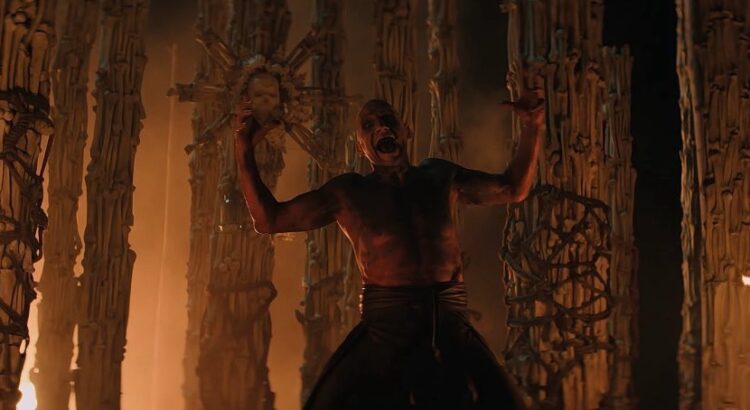
With The Bone Temple, the 28 franchise doesn’t just continue: it deepens, challenges, and evolves in ways that few long-running horror series ever manage. What’s truly astonishing is that this is a January release, a sequel to a sequel, arriving barely a year after 28 years later – and yet it confidently stands as one of the strongest entries in the entire saga.
Picking up almost immediately after the wild tonal whiplash of 28 Years Later, The Bone Temple leans into the chaos rather than retreating from it. The previous film ended with Jack O’Connell’s Jimmy and his cult of identical blonde-wigged devotees – “the Jimmys” – descending on Spike in a moment that felt like A Clockwork Orange filtered through a surreal children’s action series. It was weird, off-putting and strangely magnetic. This film takes that energy and fully engages.
At its core, The Bone Temple is a film about belief systems in a world that has lost all structure. On one side is Sir Jimmy Crystal, a religious fanatic who has turned despair into dogma. On the other, Dr. Kelson, a man of science who clings to logic, empathy, and research as the last vestiges of civilization. These two ideologies – religion and science – are placed on a collision course, not as simple substitutes for good versus evil, but as competing obsessions shaped by the same apocalyptic trauma.
The wicked, the saints and the people caught in between
Jack O’Connell delivers a defining performance as Sir Jimmy Crystal. It’s a nastiness devoid of romance. Jimmy is cruel, narcissistic and utterly ruthless, hiding his savagery behind rituals and rhetoric. O’Connell plays him with frightening confidence, making him instantly loathsome while remaining endlessly watchable. It’s the kind of performance where you find yourself counting the minutes, waiting – and hoping – for the moment when he finally understands what’s happening to him. After Sinners, O’Connell is quietly building one of the most impressive villain resumes of the decade. He’s absolutely a contender for villain of the year.
Opposite him is Ralph Fiennes’ Dr. Kelson, and we can’t overstate how extraordinary Fiennes is here. This may truly be one of the finest performances of his career. Kelson is gentle, curious, and stubbornly human, even as the world crumbles around him. He believes that science can still save something, if not the world, then at least a soul. His compassion is radical in a landscape defined by brutality, and Fiennes plays it without irony or condescension. There is a slight moral weight to his performance that anchors the entire film.
Caught between these extremes is Spike, once again magnificently played by Alfie Williams. Spike remains the emotional center of the franchise – a young person forced to decide what kind of future is worth believing in. His interactions with Jimmy’s cult and Kelson’s quiet optimism pose the film’s central question: When everything is broken, who do you follow – and why?
A notable addition is Erin Kellyman as one of Jimmy, a follower who still seems to retain a fragment of humanity. Her dynamic with Spike is subtle but deeply touching, suggesting that indoctrination is not always absolute. She feels like someone on the verge of awakening, and the film wisely leaves room for that possibility. Her presence adds emotional complexity to the cult storyline, and it’s exciting to see her positioned as a key player moving forward.
Sects as contagion
One of the most compelling ideas in The Bone Temple is the way it presents cult mentality as a parallel infection. Much like the virus, bigotry spreads through fear, isolation and despair. Jimmy’s supporters are not just bad guys: they are victims of beliefs used against them. The film draws a clear line between blind faith and survival instinct, suggesting that religion and science can become dangerous when treated as absolutes.
This thematic tension reaches its peak when Sir Jimmy and Dr. Kelson finally share the screen. Their conversation crackles with philosophical energy, not because it’s loud or explosive, but because it feels inevitable. Two men, both convinced they are right, both shaped by the same apocalypse, standing at opposite ends of what it means to “save” humanity.
An unexpected humanity among the infected
One of the most surprising and effective elements of the film is the relationship between Dr. Kelson and Samson, the infected alpha played by Chi Lewis-Parry. Their dynamic sometimes evokes the energy of a stoner buddy movie, not because it’s played for laughs, but because of its laid-back, oddly tender pace. Scenes of the two lying in the grass, dulled by morphine, accompanied by dripping needles, introduce moments of quiet absurdity that humanize the infected without ever defusing the horror.
These sequences don’t make The Bone Temple a comedy, but they add texture. They remind us that even in a world defined by violence, moments of strange camaraderie can still exist. Samson becomes more than a monster; it becomes a presence, a friend and a quiet challenge to everything we think we understand about infection.
Production, sound and metal apocalypse
Nia DaCosta deserves huge credit for her directing. Rather than attempting to replicate Danny Boyle’s unmistakable style, she leans into it, borrowing the franchise’s kinetic energy while asserting her own voice. The camerawork is visceral, the pacing confident, and the film never feels like it’s imitating what came before. This is undoubtedly a Nia DaCosta film that understands the DNA of all 28 universes.
Musically, the absence of the Young Fathers score from 28 Years Later is noticeable, especially given the power of that music. However, The Bone Temple compensates with carefully chosen needle drops – notably a searing Iron Maiden track – that elevate the film’s final act into something transcendent.
The last 15 minutes are pure, unfiltered catharsis. It feels less like a movie climax and more like a heavy metal ritual, erupting into chaos, violence and spectacle. The crowd cheering, chanting and clapping wasn’t exaggerating – it’s one of those endings that instantly becomes part of franchise history.
And then there’s Cillian Murphy.
His return is fluid, striking and deeply satisfying. The film doesn’t overdo it or treat it like a gimmick, it just reintroduces it like it never left. The final moments all but confirm that the closing scene of The Bone Temple will be the opening chapter of the next film, and it’s impossible not to feel excited about the direction this is taking.
Final Thoughts
It’s surprising to say this in mid-January, but The Bone Temple is already in the top 10 films of the year. It’s ambitious, brutal, thoughtful and rich in emotion. Few horror franchises dare to interrogate belief systems so deeply while delivering unforgettable spectacle – and even fewer succeed.
The 28 franchise isn’t just back. She is doing the most interesting work of her entire life.
And honestly? I can’t wait to see how this all ends.
28 years later: The Temple of Bones = 82/100
Agen Togel Terpercaya
Bandar Togel
Sabung Ayam Online
Berita Terkini
Artikel Terbaru
Berita Terbaru
Penerbangan
Berita Politik
Berita Politik
Software
Software Download
Download Aplikasi
Berita Terkini
News
Jasa PBN
Jasa Artikel
News
Breaking News
Berita